A quick guide to pumps available in New Zealand
We are tired. Managing our 2 year old son’s (Sam) type 1 diabetes (T1D) with Multiple Daily Injections (MDI) is a lot of work. It’s normal to get up and give food or insulin multiple times a night, and it is necessary to give multiple injections at precise times during meals.
We need a better tool! The best tool available is an insulin pump. MDI is coarse, we give 8–10 giant doses of insulin per day. A pump, on the other hand, is fine grained, it can give hundreds of tiny doses a day.
A pump can also be driven by an algorithm that can read Blood Glucose Levels (BGL) from a Continuous Glucose Monitor (CGM) and decide how much insulin is needed. The best algorithms available at the moment are called Hybrid Closed Loop (HCL). Hybrid because it still requires user input the amount of carbs eaten; Closed Loop because it automatically delivers insulin according to BGL.
With a pump we should be able to improve time-in-range (TIR), where blood sugars are between 3.9–10mmol/L, while reducing the amount of burden and stress on us as parents who are managing a T1D toddler.
However, choosing a pump is a huge commitment. The cost to purchase is between $5,000-$10,000, additionally hundreds a month in ongoing consumables and support. If you are lucky and get a pump funded through insurance or healthcare, they won’t let you change pumps for at least 4 years, potentially forcing you to live with a bad choice for a long time.
I am writing this post as a quick guide/review/justification for pump selection. This is focused towards a T1D toddler in New Zealand, but should be of some use to others as well.
_This is not medical advice! Also, double check all the presented specifications/features because they change quickly and we have not had first hand experience with any of these pumps._The pump requirements for a T1D toddler are a little different than an adult:
- Small and light: as the pump will be attached to Sam 24/7. He will break it if he gets annoyed with it or even notices it.
- Infusion set: the port where the insulin is administered should be small, hard to rip off, easy to apply, and with a small needle for small Sam. Typically, they need to be replaced every 3 days.
- Continuous glucose monitor: because of limited interoperability, choosing a pump is also choosing a CGM. Like the infusion sets, the CGM should be small and hard to rip off. The measurements will impact insulin dosing so it should also be accurate. Dexcom G6 (what we are with currently) is probably the best, but we have limited experience with others.
- Easy to use: we should be able to easily explain to a carer how to use it and perform the needed functions. Good safe guards as well, like maximum insulin on board and a child lock are needed.
- Remote monitoring/use: pumps are usually built to be used by the person they are attached to. With a toddler this is not the case. If he is sleeping or running around, it would be good to not have to wake him up or chase him to give him insulin. If we are sleeping, I want to be able to quickly check his BGL and be alerted if there is something wrong. We can never have a good nights sleep if we are not 100% confident we will be woken up if something is wrong.
- Smart algorithm: An HCL algorithm would remove a ton of work. Each algorithm is unique so comparisons are mostly about features and clinical evidence.
- Support and training: We need support and training for us and our diabetes team. If something is going wrong, we need to be able to troubleshoot.
There are a few other features that would be nice:
Waterproof for baths, showers or swimming
No phone required to operate the HCL. Given the pitiful range of bluetooth and the speed Sam can run, this might be a good idea.
Replaceable batteries.
Future developments. With things moving so fast, being stuck on an old system for 4 years would be painful.In New Zealand, there are two (only two!) funded pumps and one unfunded pump that fits our criteria:
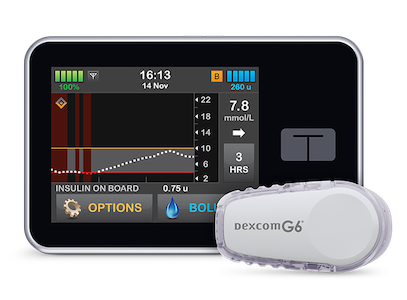
Tandem t:slim X2 + Dexcom G6 (funded)
Medtronic 780G + Guardian 4 (funded)
Dana-I + Dexcom G6 (unfunded)#### Tandem t:slim X2 + Dexcom G6
- Small and light: Very thin, but heavy: 79 x 51 x 15mm and 112 grams
- Infusion set: We were recommended the TruSteel infusion set with 6mm metal needles. The size may limit the location of the sites.
- CGM: Dexcom G6, our preferred CGM. Lasts 10 days, easy to apply, accurate.
- Easy to use: The touch screen is a bit clunky and easy to mis click on. It had a good child lock, and the menu seemed intuitive.
- Remote monitoring/use: No remote bolus. The pump connects directly to the Dexcom transmitter, so no phone is needed. You can continue to use the Dexcom app with the Follow and Clarity apps for alerts and metrics. The pump itself is not connected to the phone (yet), so seeing what the pump is doing requires physical access.
- Smart algorithm: Control-IQ, which recently made its way to New Zealand, is not licensed for under 6 year old (or under 25kg). Basal-IQ can be used with toddlers, it will suspend basal doses if his BGL gets too low. This is an excellent safety feature, but not as smart as an HCL.
- Support and training: Excellent support from the team at NZMS.
Other notes:
- It is not water proof
- Internal battery requires charging every few days
- To get history the pump needs to be plugged into a computer
- It is widely used in New Zealand and we talked with some parents using it and they love it.
- Tandem are working on remote bolus, but it will probably take a while to get to New Zealand
Links
- Product Page
- Manual
- Brown SA, Kovatchev BP, Raghinaru D et al (2019) Six-month randomized, multicenter trial of closed-loop control in type 1 diabetes: This is the longest randomised controlled closed-loop study to date, involving 168 people with type 1 diabetes (age ≥ 14 years) showing mean improvement of time-in-range of more than 10%.
Medtronic 780G + Guardian 4
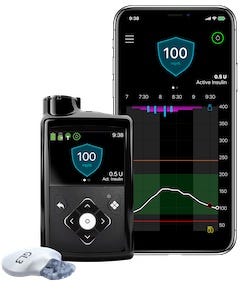
- Small and light: bulky and awkward. 54 x 97 x 25mm and 106 grams
- Infusion set: 6mm steel needle site was recommended.
- CGM: Guardian 4 is a bit finicky to apply, only lasts 7 days. It takes longer to activate than Dexcom G6 and has slightly worse accuracy. It isn’t bad, it is just slightly worse in many areas to the G6.
- Easy to use: Physical buttons, no touch screen. Looked easy to use. Has a child lock, and inputing carbs was pretty straight forward.
- Remote monitoring/use: No remote bolus. The pump connects to an app which has a share feature so we can see what the pump is doing anywhere, and be alerted if something is wrong.
- Smart algorithm: SmartGuard HCL looks amazing. It has no weight restriction and available for 12+months kids. It removes a ton of the work and setup and will learn insulin sensitivity. SmartGuard works without being connected to a phone.
- Support and training: It has excellent support and training through Intermed
Other notes:
- Replaceable AA batteries
- Waterproof sites
- Even if the pump is funded, the Guardian 4 CGM won’t be(!). So using SmartGuard will still cost money.
- Medtronic are working on remote bolusing and longer lasting infusion sets [link] but won’t be available in New Zealand anytime soon.

Links:
- Manual
- Product Page
- Silva JD, Lepore G, Battelino T, et al. Real-World Performance of the MiniMed™ 780G System: First Report of Outcomes from 4120 Users. This shows solid time-in-range results with minimal hypos.
Dana-I + Dexcom G6
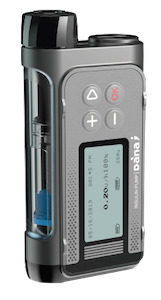
- Small and light: lightest pump, not as thin as t:slim but not awkward like 780G. 85mm x 44mm x 19mm and 86 grams
- Infusion set: Comes with the smallest 4.5mm needles. This is tiny for tiny Sam.
- CGM: Dexcom G6, our preferred CGM.
- Easy to use: The pump itself has a very simple interface, but in our case most of the interactions will be with the CamAPS app (which looks amazing!).
- Remote monitoring/use: Remote bolusing through CamAPS!!! Alerts via SMS to up to 5 phones. Uploads the pump and CGM data to diasend every 5 minutes, the only way to remotely monitor the Sam. xDrip works with CamAPS as a workaround for sending information to other locations like Nightscout.
- Smart Algorithm: CamAPS is available and looks amazing. It seems to have the best clinical results out of any commercial HCL. It has a lot of features, like boost, which would make parenting much easier. It is possible to use AndroidAPS but that doesn’t have an HCL in stable release (yet).
- Support and training: Intuitive Therapeutics is a small company that sells and provides pump support and CamAPS provides app support from UK. This pump is not funded so does not have widespread use in New Zealand, that is a risk.
Other notes:
- $5,500 NZD for the pump. Add to that, about $160 a month in consumables, $130 a month for CamAPS, and $400 for Dexcom G6, the first year will cost about $14,000. That takes this pump out of reach for many. We have private insurance which will hopefully cover about 1/2 of that.
- Replaceable AAA batteries
- CamAPS is only available on Android, and the phone is required for operation. So keeping a phone in range is a must otherwise the pump will fall back to default settings.
- CamAPS has said they will sync to Dexcom in the future (though I found an article saying that it was promised in 2020). This would allow Dexcom integrations like the Follow and Clarity apps, as well as other.
I think Dana-i with CamAPS is an amazing system. Not being funded means not as many people can use it.
Links:
- Manual
- Dana-i Product Page
- CamAPS FX app page
- Webinar introducing CamAPS FX
- Review/Overview of CamAPS and One Month Followup
- Tauschmann M, Allen JM, Nagl K et al (2019) Home use of day-and-night hybrid closed-loop insulin delivery in very young children: A multicenter, 3-week, randomized trial. __ This shows CamAPS to be good for young children AND that diluted insulin provided no benefit.Given the above information, our order of preferred pump is:
- Dana-i with CamAPS + Dexcom G6. This has solid results for an HCL for 2 year olds. Has a super easy interface. Is slightly let down on the remote monitoring and alerting. The big negative here is no funding.
- MiniMed 780G. SmartGuard looks amazing and can be used by a 2 year old. The main negatives are the awkward shape and size of the pump to be carried by a toddler, and no remote bolusing or control. Also, Guardian G4 is just slightly worse than Dexcom G6 in most areas.
- t:slim x2. Control-IQ not being available for 2 year olds, and not being able to remotely monitor the pump are the big negatives. The size and shape are positives. If Sam was older and managing his own T1D we might have selected this pump.
This is of course a personal choice. Others will have different priorities for their pumps, but hopefully this helps.Two honourable mentions for pumps are:
- YpsoPump + Dexcom G6: Is a small light pump that has some cool features and glass cartridges so they can be pre-filled and stored in the fridge. The version sold in New Zealand is not the two-way communication model, but that newer model works with CamAPS soon (very soon). Hopefully, PharmaCo who supplied the YpsoPump, will upgrade their model to be CamAPS compatible soon.
- Omnipod 5 + Dexcom G6: This is our dream pump. It being tubeless, app controlled, with an HCL(!) would be awesome for Sam. It is just very new, and it doesn’t look like the manufacturer will ever be available in New Zealand. Moving to USA/Australia just to get access to this has crossed our minds.Other links
- Table comparison of pumps [link]
- Clinical studies for CamAPS [here, here]
- Boughton, C.K., Hovorka, R. New closed-loop insulin systems (2021) discusses all three (CamAPS, Control IQ, SmartGuard) HCLs above. This is the best one stop discussion of the current state of HCLs. Table 1 comparison of HCL systems
- The Algorithm for Precision Medicine by Matt Might